
How to Calculate Hydraulic Cylinder Force, Capacity, and Tonnage
Calculate hydraulic cylinder extension and retraction force from pressure and effective area, then adjust for losses, linkage geometry, and safety factors.
Guides de sélection, de dimensionnement et de spécification des vérins hydrauliques.
Calculate hydraulic cylinder extension and retraction force from pressure and effective area, then adjust for losses, linkage geometry, and safety factors.
Order a hydraulic cylinder rebuild kit from the cylinder manufacturer, part number, serial number and verified seal dimensions whenever possible. Bore and rod size alone are insufficient because seal profiles, groove dimensions, materials, wear bands and revision levels can differ.
Measure hydraulic cylinder bore from the finished internal tube diameter, not the outside barrel diameter. The reliable value comes from a controlled drawing or safe disassembly followed by internal measurements at multiple depths and clock positions to identify diameter, taper and out-of-round condition.
Identify a hydraulic cylinder by its nameplate or part number first, then verify machine function, cylinder type, bore, rod diameter, stroke, retracted length, mounts, pin sizes, ports and orientation. Paint color or overall appearance is not enough for an accurate replacement.

Designing a hydraulic cylinder starts with machine load cases and geometry, then converts those requirements into bore, rod, stroke, mounting, materials, sealing, ports, cushioning and verification criteria. A reliable design is a documented system decision, not a bore-and-pressure calculation alone.
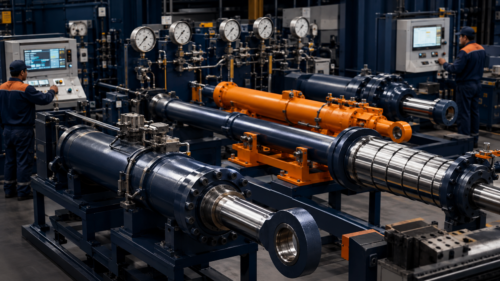
When a hydraulic lift uses two 3-inch-bore cylinders, the ideal extension area is the sum of both piston areas. One 3-inch piston has about 7.07 square inches of area, so two equal cylinders provide about 14.14 square inches before efficiency, geometry and safety factors are considered.
Choose a hydraulic cylinder by defining the machine function first, then verifying force through the real linkage, available pressure and flow, stroke and
Hydraulic cylinder speed is determined first by oil flow divided by the active piston area, but no universal maximum applies to every cylinder. Safe speed
Hydraulic cylinders are rated through a combination of working pressure, bore, rod diameter, stroke, force, speed, mounting, stability, duty cycle
To measure a hydraulic cylinder for replacement, identify its function and part number first, then record retracted and extended pin-to-pin length
 English English
 Russian
 Spanish
 Arabic
 French
 Portuguese
 Vietnamese